



fleet and driver compliance solutions

WE KEEP YOU MOVING

Facilitating the growth and prosperity of the trucking industry.

fleet compliance services

vehicle compliance

Vehicle Titling, Registration, and Permitting for Motor Carriers (private or for-hire): To legally operate a Motor Carrier in the U.S., you must comply with titling, registration, and permitting requirements at the federal and state levels.

DRIVER COMPLIANCE

Driver compliance with the Federal Motor Carrier Safety Administration (FMCSA) is essential for maintaining the safety of both commercial motor vehicle (CMV) drivers and the public. Here are the key compliance areas: Driver Qualification Requirements; Drug and Alcohol Testing Compliance.

DOTFocused software

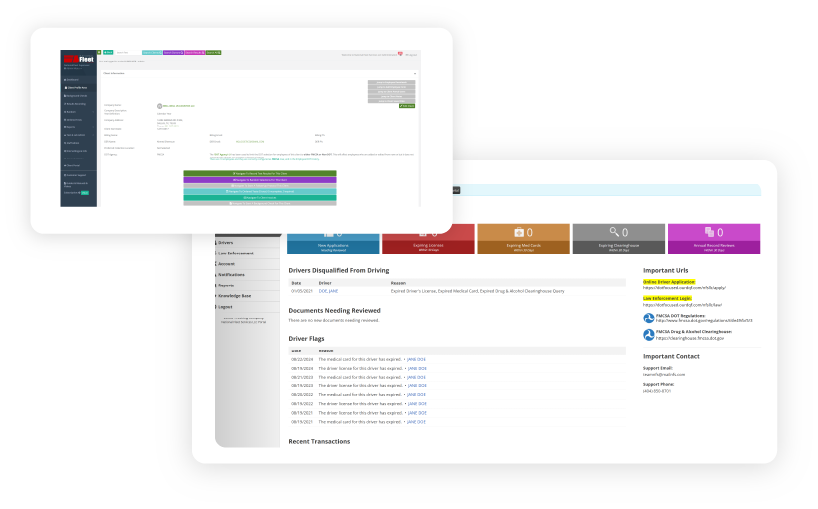
National Fleet Services DOTFocus software specializes in providing online Department of Transportation (DOT) Driver Qualification (DQ) software, designed to streamline and automate the compliance process for commercial carriers and CDL drivers. ​

Two screenshots of a dashboard with data displayed, using a color-coded interface.

Key Features of DOTFocused Software:

  • Online Driver Application: Prospective drivers can complete DOT-compliant employment applications through an online portal, simplifying the hiring process. ​


  • DOT PSP and State MVR Reports: The software integrates directly with DOT systems to provide instant Pre-Employment Screening Program (PSP) reports and State Motor Vehicle Reports (MVRs), aiding in thorough background checks. ​


  • Automated Compliance Tracking: The system monitors critical dates such as driver's license and medical card expirations, and automates annual reviews, ensuring ongoing compliance with DOT regulations. ​
  • Electronic Documentation: All necessary forms are available electronically, allowing for online completion and electronic signatures, reducing paperwork and administrative burden. ​

  • Multilingual Interface: The platform supports both English and Spanish, making it accessible to a diverse user base. ​

we helped keep these clients on the road

DOTFocused is Simple & Easy to use Across all Devices

Stop wasting time and money using old fashioned paper filing systems rife with human error.

Red semi-truck on a highway, hauling a trailer, overcast sky in the background.

You'll be en route to success

National Fleet Services LLC is committed to providing motor carriers a lower cost alternative service offering for the essential “in-house” compliance requirements. We are devoted to “giving back” to the continued health and future growth of the trucking industry, and in doing so, helping to ensure future opportunities for motor carriers to grow and prosper.

Any questions? We Have Answers

  • I want to open a new trucking company, what do I need?

    • Register your business and trademark the name
    • File for an EIN with IRS
    • Obtain a USDOT number & Authority
    • Obtain a BOC-3 Agent & Insurance
    • Obtain an IRP and IFTA account
  • How much does it cost to get your own trucking authority?

    The FMCSA charges $699 to file the paperwork and get your authority issued.

  • What is a BOC-3 processing agent?

    It’s an FMCSA agent or business that receives legal documents on behalf of a company. This includes court papers, complaints, and summons. Our related company 1+49 Process Agents LLC provides agents in all 50 states.

  • What is UCR?

    It’s an annual fee that all individuals or companies that operate commercial motor vehicles across state or international lines must pay based on the number of vehicles.

  • What is biennial?

    It’s an update with the FMCSA that requires entities to update their information every two years.

  • What is IFTA?

    It's a fuel tax collection and sharing agreement for the redistribution of fuel taxes paid by interstate commercial carriers.

  • What is HVUT?

    The heavy vehicle use tax or HVUT is a fee assessed annually on heavy vehicles operating on public highways at registered gross weights equal to or exceeding 55,000 pounds.

  • I bought a truck; how can I get it registered and get my plates?

    You will need to title the vehicle first with your local county and then add it to your IRP account.

  • I am running under somebody else’s authority; can I open an IRP account?

    Yes, as long as you have an Employment Agreement.

  • How does your drug & alcohol consortium work?

    We send drivers for a pre-employment test and once negative results are received, we will add the driver into our drug pool. Testing is conducted at a designated site across the US.

  • I’m the owner, but I don’t drive why do I have to be enrolled in a consortium?

    As an owner-operator of a commercial vehicle, even if you don't personally drive, you are still required to be enrolled in a consortium because DOT regulations prohibit single owner-operators from managing their own random drug and alcohol testing program.

  • I am enrolled in your consortium, but I have not been tested randomly, why?

    If you are enrolled in a drug testing consortium but haven't been randomly tested, it's likely because random selection is based on a large pool of drivers from different companies, meaning the odds of being chosen for a test at any given time are relatively low, especially if your company has a small number of drivers; essentially, your chances of being selected are diluted by the larger pool within the consortium. 

  • What is the Return to Duty process?

    It's a series of steps that an employee must complete to return to a safety-sensitive job after a drug or alcohol violation. The process includes evaluation, education, treatment, and testing. 

  • What is the FMCSA Portal? What do I need to open one?

    It’s an online platform that allows users, including carriers, brokers, and state officials, to access various safety data and information systems related to commercial vehicles with a single set of login credentials.  What do I need to open one? You will need to request your USDOT Pin and create a Login.gov account.

  • What is the Clearinghouse? What do I need to open one?

    It's a central repository to track CDL driver drug and alcohol test results and return-to-duty information.  What do I need to open one ? You need a valid email address and to create a login.gov account. You can use your existing login.gov account if you already have one. 

  • What is a Query?

    Detailed information about any violations found in a driver's Clearinghouse record. 

  • I drove zero miles this quarter, do I need to file an IFTA return?

    Yes, you must file a separate return each calendar quarter for each fuel type indicated on your initial or renewal application even when no miles were accrued that quarter.

fleet insights

By Matthew Bowles May 6, 2026
1. Incorrect IRP Apportionment and Base Jurisdiction Registration Many carriers improperly register equipment under the wrong base jurisdiction or fail to correctly report mileage under the International Registration Plan (IRP). Common Problems: Underreporting miles in certain states Using an improper established place of business Failing to maintain operational records Registering fleets in “friendly” states without meeting requirements Consequences: IRP audits Back taxes and registration fees Penalties and interest Suspension of apportioned plates This issue becomes especially problematic during mergers, rapid growth, or owner-operator onboarding. 2. Titling Equipment in the Wrong Legal Entity Motor carriers frequently title tractors, trailers, or other equipment in: the owner’s personal name, an affiliated company, or a different operating entity than the one using the equipment. Why This Happens: Financing requirements Poor coordination between accounting and operations Corporate restructuring Leasing arrangements Risks: Sales/use tax exposure Difficulty proving ownership Insurance complications Problems during audits or DOT investigations Challenges claiming depreciation or tax credits This becomes critical when dealing with multi-entity fleet structures. 3. Failure to Properly Handle Lease-Purchase and Owner-Operator Registrations Lease-purchase programs create major compliance problems when: titles remain with the carrier, registrations are improperly assigned, or responsibility for taxes and fees is unclear. Frequent Errors: Wrong party listed as registrant Improper HVUT filings Missing lease documentation Incorrect IFTA/IRP responsibility assignments Result: Disputes during audits can lead to double taxation, penalties, or operational shutdowns. 4. Improper Handling of Sales and Use Tax on Equipment Purchases Many carriers assume: purchasing equipment out of state avoids tax, temporary permits eliminate liability, or reciprocal agreements fully exempt them. Typical Mistakes: Not paying use tax when equipment enters another state Failing to document interstate exemptions Misapplying rolling stock exemptions Poor recordkeeping for trailers and leased equipment Exposure: States aggressively audit heavy equipment purchases because tractors and trailers are high-value assets. A single mistake on fleet acquisitions can create six-figure assessments. 5. Letting Registrations, HVUT, or Compliance Filings Lapse Operational teams often focus heavily on dispatch and safety while administrative compliance falls behind. Common Lapses: Expired apportioned plates Missing Internal Revenue Service Form 2290 Heavy Vehicle Use Tax filings Incorrect VIN updates Expired trailer registrations Missing Unified Carrier Registration renewals Consequences: Roadside violations Vehicle impoundment Out-of-service orders Delays in plate renewals Increased audit scrutiny Even a minor lapse can sideline revenue-generating equipment. Additional High-Risk Areas Other recurring problem areas include: Incorrect VIN reporting Trailer fleet inventory inaccuracies Failure to transfer titles after acquisitions Misclassification of leased vs. owned assets Poor coordination between accounting, licensing, and operations teams Inadequate document retention during IRP/IFTA audits Best Practices for Carriers  Top-performing carriers usually: Centralize fleet compliance management Conduct annual IRP/IFTA self-audits Reconcile VINs across accounting, registration, and insurance systems Review entity ownership before purchases Maintain detailed mileage and equipment records Coordinate tax, legal, and operations departments before acquisitions or restructuring For large fleets, preventive compliance is far less expensive than correcting registration and tax problems after an audit.
IFTA logo in bold red letters on a gray globe, ringed by colorful cartoon trucks
May 5, 2026
Learn how to simplify IFTA quarterly filings with better data tracking, fewer errors, and practical strategies to keep your fleet organized and compliant.
By Matthew Bowles May 5, 2026
Why This Matters In an acquisition or when onboarding drivers from a bankrupt carrier, you are effectively inheriting: Regulatory exposure Safety performance history Potential audit liabilities FMCSA does not grant a grace period for incomplete or missing records. If a driver operates under your USDOT number, you are fully responsible for compliance immediately . 1. Driver Qualification (DQ) Files What a Complete DQ File Must Include Per 49 CFR Part 391 , each driver must have a compliant DQ file containing: Driver’s application for employment Motor Vehicle Record (MVR) from each state (initial + annual) Inquiry to previous employers (last 3 years for safety performance) Road test certificate or equivalent CDL documentation Medical Examiner’s Certificate (DOT physical) Annual driver certification of violations Annual MVR review with safety determination Entry-Level Driver Training (ELDT) records (if applicable) Acquisition Scenario: Key Risks When acquiring a trucking company: 1. Missing or Incomplete Files It’s common to find: Outdated medical cards Missing prior employer verifications No documented annual reviews Risk: Immediate FMCSA violations tied to your DOT number post-close. 2. Assumption of Compliance Buyers often assume: “If the company was operating, the files must be fine.” That assumption is frequently wrong—especially with distressed or poorly managed carriers. 3. Liability Transfer Even if violations occurred pre-acquisition: Auditors evaluate current compliance at time of review You must fix deficiencies before drivers operate under your authority Best Practices for DQ Files in M&A Pre-Close Due Diligence Sample and audit a percentage of DQ files Identify systemic gaps (not just isolated issues) Flag high-risk drivers (missing MVRs, expired medicals) Day 1 Readiness Strategy Before drivers operate under your DOT: Re-verify CDL and MVR Confirm valid medical certificate Complete missing employment verifications Post-Close Remediation Rebuild incomplete DQ files Document corrective actions Implement standardized onboarding processes 2. Drug & Alcohol (D&A) Testing Files Required Components Under 49 CFR Part 382 , employers must maintain: Pre-employment drug test results Drug & Alcohol Clearinghouse query results Random testing program enrollment Post-accident, reasonable suspicion, and return-to-duty records Chain of custody forms Supervisor training documentation Acquisition Scenario: Critical Issues 1. Clearinghouse Compliance Gaps Common findings: No pre-employment queries No annual queries Unresolved violations Risk: You may unknowingly place a prohibited driver on the road. 2. Random Testing Program Failures Bankrupt or struggling carriers often: Fall out of consortiums Miss random testing requirements Risk: Entire driver pool may be non-compliant. 3. Positive Test / SAP Follow-Up Gaps Drivers with prior violations may: Not have completed Return-to-Duty (RTD) process Be missing follow-up testing plans Risk: Immediate out-of-service violation. Hiring Drivers from a Bankrupt Carrier This scenario is especially high-risk because: Records may be incomplete or inaccessible Third-party administrators (TPAs) may no longer respond Drivers may not disclose violations Required Steps Before Hiring 1. Drug & Alcohol Clearinghouse Queries You MUST: Run a pre-employment query Obtain driver consent Confirm no unresolved violations 2. Previous Employer Inquiry (D&A History) For the past 3 years, you must: Request drug & alcohol testing history Document attempts—even if employer is out of business 3. Pre-Employment Drug Test Even if the driver was recently tested: A new employer must ensure a compliant pre-employment test Exception only applies under strict transfer conditions (rare in bankruptcy) 4. Verify Random Testing Enrollment Driver must be: Enrolled in your random testing program before performing safety-sensitive functions 3. Integration Challenges in Transactions Data Fragmentation Paper vs digital records Multiple TPAs or consortiums Inconsistent formats Timing Pressure Deals often close quickly, but: Compliance cannot lag operations Drivers cannot legally operate while files are incomplete Cultural Differences Acquired companies may have: Less rigorous compliance standards Informal processes 4. Strategic Recommendations Build a “Compliance Gate” Before Deployment No driver should operate until: DQ file meets minimum regulatory standards D&A file is verified and complete Clearinghouse status is confirmed Use a Risk-Based Review Approach Prioritize: Drivers with incomplete records Drivers from bankrupt carriers Drivers with prior violations or high turnover history Standardize and Centralize Records Implement a uniform DQ/D&A checklist Digitize all records Align with a single TPA or compliance system Document Everything In audits, documentation is your defense: Record all attempts to obtain missing records Maintain written explanations for gaps Show corrective actions taken 5. The Bottom Line In acquisitions or bankruptcy hiring, DQ and Drug & Alcohol files are not administrative paperwork—they are regulatory landmines . Failing to properly vet and reconstruct these files can lead to: FMCSA penalties Out-of-service orders Increased CSA scores Litigation exposure Handled correctly, however, they can become a competitive advantage—ensuring: Safer operations Lower audit risk Stronger integration outcomes

Why We Do What We Do

At National Fleet Services, we believe in more than just business - we believe in building the future of the trucking industry. Through our dedication to its growth and sustainability, we help motor carriers succedd today while paving the way for the opportunties of tomorrow.

"I can't recommend National Fleet Services enough! I had questions about obtaining our DOT number and Ana went above and beyond to make sure we were doing things correctly."


RACH HILL

Thank you for contacting us.
We’ll get back to you as soon as possible.

We got it.

Let's set the wheels in motion

We look forward to hearing from you!

This is required
Enter an email Use an address with (@) and (.)
Enter your phone number Enter a valid number like +1555-123-4567
This is required
This is required
This is required
This is required

That didn’t work.

The form wasn’t sent. Please try again.